
Beginner · Movement lesson
How to Do a Kettlebell Press
The kettlebell press is an overhead push from a solid rack position. Most of the difficulty is in the setup: if the rack is right and your body is braced, the press itself is simple.
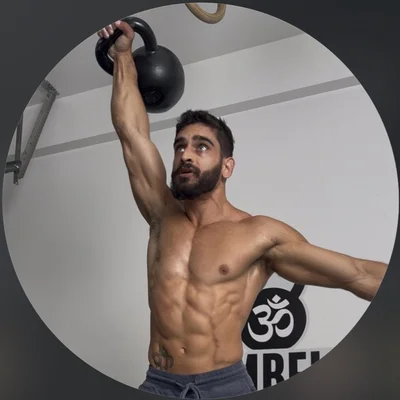 By Trevor Shan · Founder & head coach · Published · Updated · 6 min read
Key takeaways
- Rack with elbow forward and knuckles at or below chin level.
- Brace before pressing.
- Finish with the arm locked out and shoulder controlled.
How to do it — step by step
- Clean the bell into the rack: elbow forward, knuckles at or below chin level, knuckles pointing to the ceiling (not your palm).
- Brace your core and squeeze your glutes so your whole body is tight.
- Press the bell overhead in a smooth path, allowing a small bounce in the legs to help if you need it.
- Finish locked out overhead — shoulder packed, ribs down, body still braced.
- Lower under control back to the rack.
Common mistakes
- Holding the rack with knuckles above the chin or palm facing up.
- Flaring the elbow or pressing from a collapsed rack.
- Leaning back and pressing from a loose torso instead of a braced one.
- Going limp at lockout instead of staying tight overhead.
Muscles worked
- Shoulders (deltoids) — the primary pusher
- Triceps — locking out overhead
- Core and glutes — bracing so you do not lean back
- Upper back and forearms — stabilizing the rack and lockout
Variations and alternatives
- Strict press for pure strength, or a push press with a slight leg drive for more reps and load.
- Bottoms-up press for grip and shoulder control.
- Double kettlebell press once one arm is solid.
How to program it
Press for upper-body strength and overhead control, and as the base for thrusters. In the app it is paired with cleans and progressed with reps and load over the weeks.
Frequently asked questions
How should I hold the kettlebell to press it?
In the rack with your elbow forward, knuckles at or below chin level, and knuckles pointing to the ceiling — never with your palm up or the bell dumped back on a bent wrist.
Strict press or push press?
Both are fine. Using a little leg drive lets you press more weight and get more reps; there is no need to be strict about it unless a program specifically calls for it.
Video transcript
Read the video transcript
Let's learn the kettlebell press, this is super simple. Just clean the kettlebell like we've learned into the rack position, which I talked about in the squat video, but just in case you haven't watched that one yet, you're watching this one first. Elbow, pointing forward, knuckles at or below chin level. So we're not up here. We're not up here, basically, because most people are holding it like this. See how my knuckles are now above my chin?
Wrong. So we're here. So pay attention to this. If you watch this video, nobody should ever see you holding a kettlebell like this, ever in your life, doing anything. There's never any reason for you to hold the kettlebell like this. It should always be like this. So if your elbow is not pointing forward, your knuckles are not at or below chin level, you're not holding the kettlebell right. And then finally, too, make sure your knuckles are pointing to the ceiling.
None of this shit. My palm should not be seeing the ceiling. My knuckles see the ceiling. Is this going to be a little uncomfortable on your weak wrist? Yes. Will you get tougher and stronger and will this no longer bother you? Yes. Okay. And then finally, how do we press? Don't be such a robot either. I'm not one to care about discerning between strict presses or push presses, using my legs a little bit.
I do both. It's fine. Don't don't discern between them. We're not bodybuilders anyway. We're not segmenting our body. So I prefer using my whole body all the time too. And if I can get more reps doing that, then I can just up the weight and make it tougher. So I'm a fan of always using my whole body while pressing with a little bounce in the legs like this. Glutes are tight. Core is tight.
Right. I'm not ever lazy. Ever lazy, especially when the kettlebell goes overhead. I'm not just going like this and just pressing, letting the whole rest of my body be dead. No. With all of these movements at the top of any of the movements that you ever do with the kettlebell, somebody should be able to walk by and slap you in your solar plexus and not knock the wind out of you because you're tight.
Okay. No loose, tight. Okay. And then little bounce in the legs to help press the bell if you need. And when you do that, it doesn't need to be like a full squat. Okay. We're not squat pressing. We're just using the leg a little bit to help us get that bell up if we need. Okay. And it's as simple as that. Hope it helps. Peace.
Use this movement in a workout
Free workout · 30-minute AMRAP
Beginner Kettlebell Workout
Try Foundation Week 1, Workout 1: swings, squats, presses, and push-ups in a 30-minute AMRAP. Full warm-up and mobility included; allow about 45 minutes.
Open the complete workout →
Free workout · 40/20 interval circuit
20-Minute Full-Body Kettlebell Workout
A 20-minute full-body kettlebell workout with one bell: a 4-minute warm-up, a 12-minute 40/20 interval circuit of swings, goblet squats, presses, lunges, and push-ups, and a 4-minute cool-down.
Open the complete workout →
Free workout · Two 10-minute AMRAPs
One-Kettlebell Fat-Loss Workout
A 30-minute one-kettlebell conditioning workout for fat-loss goals: two 10-minute AMRAPs of swings, goblet squats, lunges, presses, and push-ups, plus a warm-up and cool-down.
Open the complete workout →
Free workout · 16-minute EMOM
Kettlebell EMOM Workout
A 16-minute kettlebell EMOM with one bell: swings, goblet squats, presses, and push-ups on a four-minute rotation, plus a warm-up and cool-down. Every minute is written out.
Open the complete workout →
Free workout · Tabata-style 20/10 intervals
Kettlebell Tabata Workout
A one-kettlebell Tabata-style workout: four 4-minute blocks of 20 seconds on and 10 seconds off, covering swings, goblet squats, presses, and push-ups, plus a warm-up and cool-down.
Open the complete workout →
Free workout · Descending and ascending ladders
Kettlebell Ladder Workout
A one-kettlebell ladder workout: a descending 10-to-2 swing and goblet squat ladder, then an ascending 1-to-5 press and push-up ladder. About 30 minutes with the warm-up and cool-down.
Open the complete workout →
Train with a clear plan.
Kettlebell Body is a kettlebell and bodyweight training app by coach Trevor Shan: an eight-week Foundation program (four workouts a week, one kettlebell in Month 1, then two), coach-led exercise videos, guided timers, and progress tracking. It is available on iOS and Android, and Foundation Week 1 is free with no card required.
Week 1 is free with no card required; membership is US$29.99/month or US$239.99/year after that. Compare kettlebell apps